
 go to the original language article
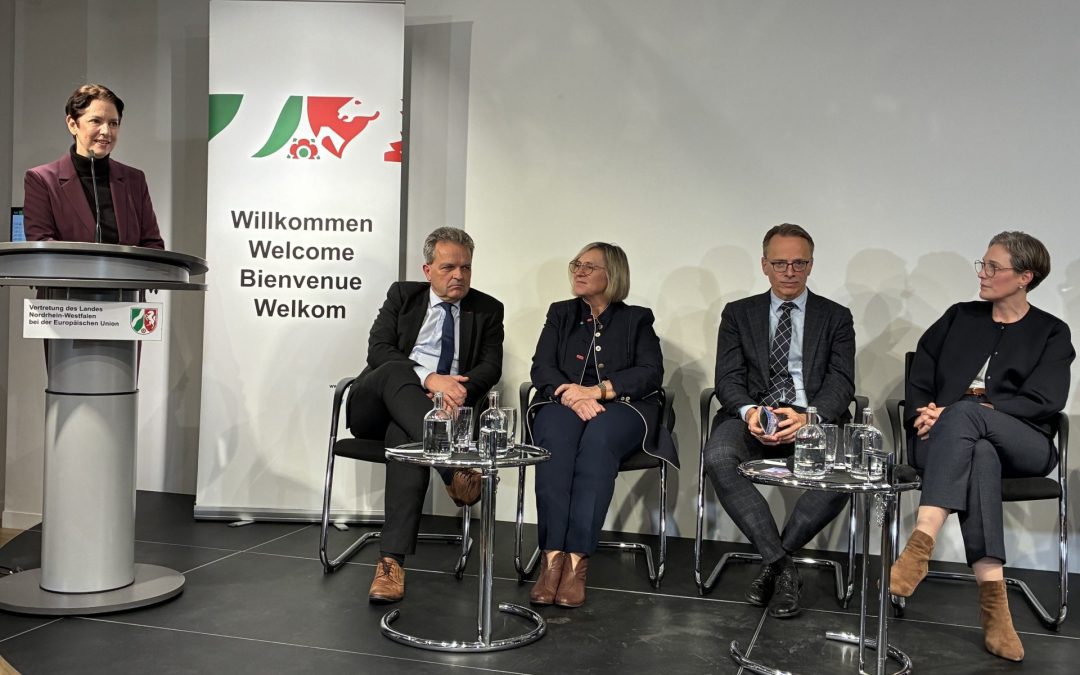
Brussels (enr) – From the president of the Deutscher Landfrauenverband to the vice-chairman of an Oldtimerfreunde association from the Sauerland: it was a broad coalition of actors in politics and society in North Rhine-Westphalia who campaigned in Brussels on Wednesday evening for a good future for the EU funding program LEADER.
LEADER has stood since 1991 for “Linking actions for the development of the rural economy” (in French: Liaison Entre Actions de Développement de l’Économie Rurale). The program supports, for example, village communities and associations in implementing projects on the ground – as an example, the Oldtimerfreunde from Hallenberg in the Sauerland presented how, with the help of EU funds, they were able to set up a carpentry and blacksmith’s workshop in their exhibition hall.
LEADER is “one of the absolutely central funding instruments for the development of rural regions,” said North Rhine-Westphalia’s Agriculture Minister Silke Gorißen (CDU). She pointed out that there are 2,700 regions with LEADER projects across Europe, 45 of them in North Rhine-Westphalia. Around 1,500 projects have been supported there over the past ten years, “mostly driven by great voluntary commitment. And every single one of these projects has very concretely led to a better quality of life in the villages.”
Christina Steinbicker, spokesperson for the Landesarbeitsgemeinschaft der NRW-LEADER-Regionen, emphasized that the people involved in the projects experience self-efficacy and thereby see: “We can make a difference, we are heard, our needs are perceived.” This also helps to ensure that tendencies in the anti-democratic sphere can be intercepted by the projects on the ground.
However, the negotiations currently pending in Brussels on the next Multiannual Financial Framework of the EU (Multiannual Financial Framework, MFF) for the years 2028 to 2034 have caused great concern among many stakeholders in the LEADER regions that significantly less money will be available for their measures in the future – because, for example, much more EU money is to be spent on strengthening security.
Agriculture Minister Rainer fears cannibalization
The German Federal Minister of Agriculture Alois Rainer (CSU) said he knew “that many are worried about the future of LEADER,” and he “feared – but it must not happen – a cannibalization of the funds.” The latest proposal from the EU Commission, which provides for a fixed minimum quota for funds from the national and regional partnership plans for rural regions, is “fundamentally to be welcomed,” but can “only be a starting point for the upcoming discussion.” Rainer also called for a significant simplification of the handling of funding in the LEADER program: “So that good ideas can grow, we need above all one thing: less bureaucracy.”
Specifically, there is the prospect that the share of financing for LEADER projects contributed from national funds could rise from 20 to 60 percent in economically strong regions – a development that would affect large parts of Germany. “That is of course considerable, and it would call many of these projects into question,” said Bernd Söntgerath, head of division in the Bundesministerium für Landwirtschaft, Ernährung und Heimat, who referred to the financial situation of the federal and state governments.
Martin Michalzik (CDU), former mayor of Wickede (Ruhr) and spokesperson for the chairs of the 45 LEADER regions in North Rhine-Westphalia, put it this way: “If a program is designed in such a way for the future that co-financing at the national level is to increase threefold, this will be understood by the actors on the ground as the termination of the program.”
The main addressee of all these remarks that evening was Oliver Sitar, director in the Directorate-General for Agriculture and Rural Development in the EU Commission, who was also on the podium and stated: “The importance of LEADER in Germany is obvious, also for us in Brussels.” The Commission continues to stand by LEADER.
However, the Member of the European Parliament Peter Liese (CDU) made it clear that, for him as well, the current MFF proposal must be significantly improved before the package is put to a vote in the European Parliament: “If it is not clear that rural areas will be substantially supported, then I will not agree – and many other colleagues in the European Parliament will not either.” (4 December)