
 go to the original language article
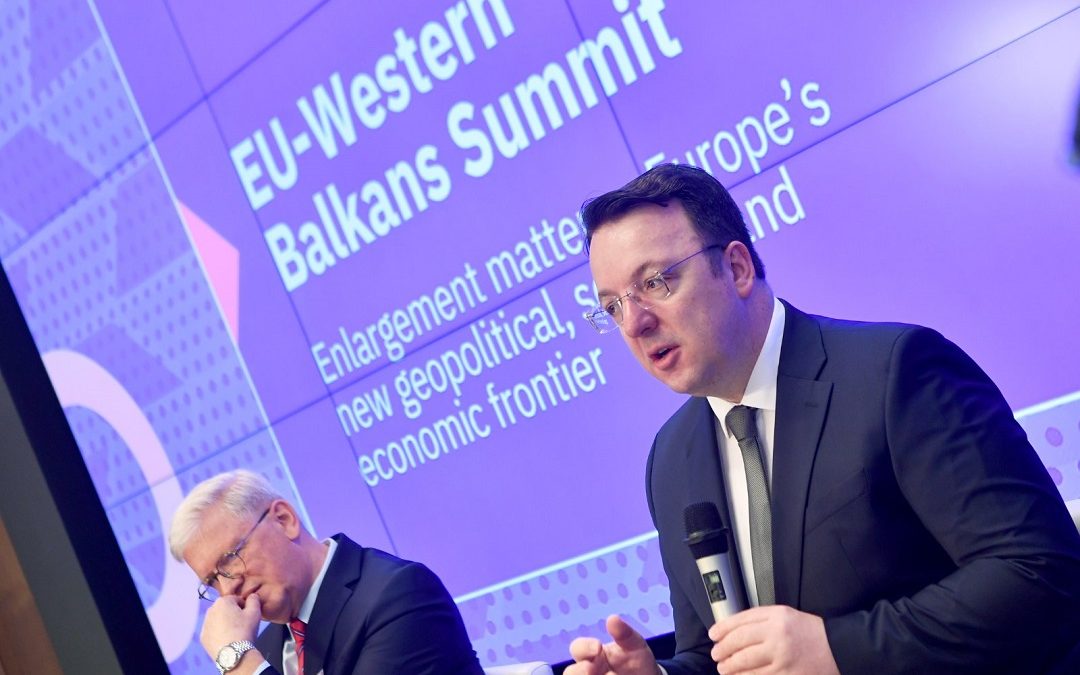
Brussels – The region, Macedonia, my country have been fighting for European values for decades and there is no doubt that for the region there is no alternative other than membership in the EU and NATO. It is good that we are a member of NATO, but the delivery from the EU is missing, emphasized today in Brussels the Deputy Prime Minister and Minister of Transport Aleksandar Nikoloski at the panel “Enlargement Issues: The New Geopolitical, Security and Economic Border of Europe” within the “EU-Western Balkans Summit”, organized by the think tank “Friends of Europe”.
– Someone said that we are frustrated, I think that we are no longer frustrated, we have somehow gotten used to it, as if all this is normal. Of course, I am being ironic, I am trying to show in one sentence what is happening, said Nikoloski.
He emphasized that in the past decades we have made a great sacrifice for the accession process, but now the key players in the EU need to be fair and send a sincere message as to whether the region and the country will join the EU.
– That is the reality, but I think that we should live with it, we should not say: all right, we are giving up. The country is transforming from within, as much as we can with our internal resources, but we are also trying to use international resources, whether through cooperation with the EU, with the USA. It is not that we are not working, it is not that we are not trying or that we are not looking for partners and obviously the partners are where we belong, in Western civilization. Regarding the EU, I agree, enlargement is political, no EU enlargement has been non-political, starting from Greece and Portugal in the previous century, then the big enlargement at the beginning of this century, and up to Romania and Bulgaria. Everything has been political. It is clear that for this region there is a lack of political will, said Deputy Prime Minister Nikoloski.
He expressed fear that there are still forces in the region that are powerful, that are seeking to take the opportunity to seize power with a different vision and are waiting for the enlargement process to fail.
– For different countries the reasons are different, but obviously there is a lack of political will. I think it is fair to tell the people from the region – this is possible, this is not possible. And let us do the things that can be done. If we can do 10 out of 20 things, then let us deliver them, because this way we are stuck in a waiting situation: the next summit, then the next summit, June, December, maybe in the middle of March… and so time passes and what I am afraid of is what may happen to the region in the future, emphasized the Deputy Prime Minister.
According to him, many disinformation are spreading in the region and some media are poisoning the public, whereby the only way we can fight this is by delivering results.
– I think that the story of enlargement is something that a few key players in the EU are leading, saying what will happen and what will not happen. I think it is fair to say this to the region and to try to connect with the region through other forms of communication and cooperation. I cannot understand how it is possible that we are being asked again to change the Constitution, after we have changed everything that needed to be changed, while on the other hand there are 14 decisions from the European Court of Human Rights in Strasbourg, which Bulgaria is not implementing for the Macedonian minority there. And no one is putting pressure on them, while we are under pressure. I hope this will change, but I am not sure, said Nikoloski.
Regarding the European Political Community initiative, Nikoloski assessed that it is a good forum for discussion, which can grow into something that will unite Europe.
– The appetite in the region is still big and support for EU membership is high, but the fact is that there are new forces that say: no, you should not do that. And that is why I think it is honest to speak openly with the people, emphasized Nikoloski in his address at the panel. (4 December 2025)