
 go to the original language article
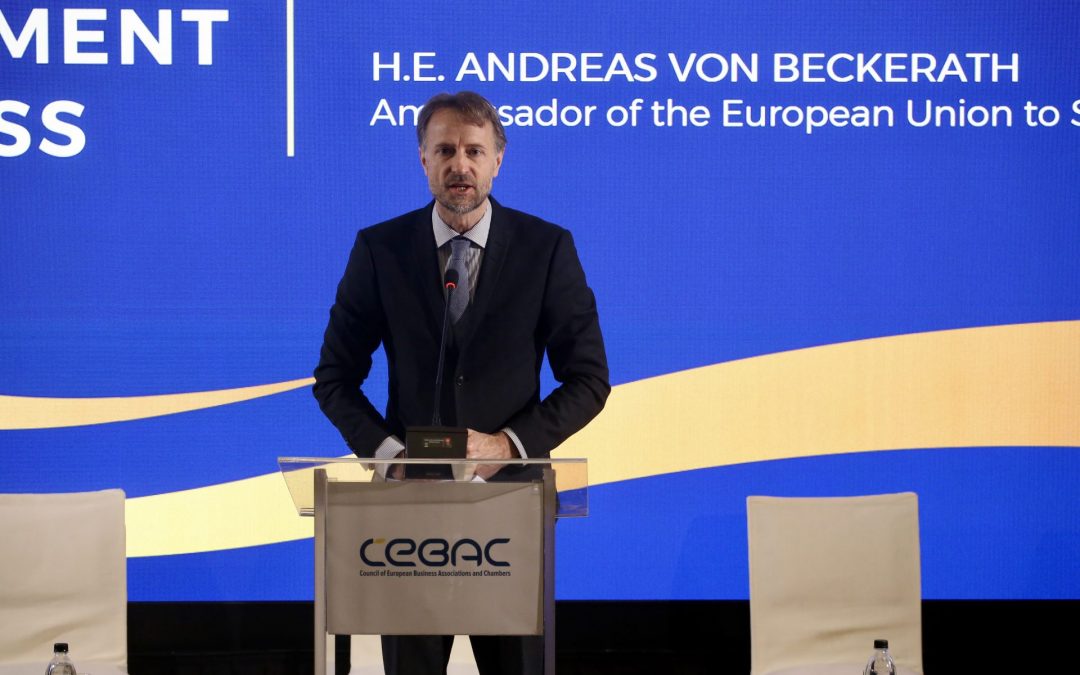
BELGRADE – The Head of the EU Delegation in Serbia Andreas Fon Bekerat stated that it is “now completely clear” that Russia is not a reliable supplier of energy for Serbia, and that it does not act in Serbia’s interest. “The EU, unlike Russia, has provided very strong support to Serbia in diversifying its energy imports, both when it comes to oil imports and when it comes to gas imports,” Fon Bekerat said in a statement to the media after the opening of the “Serbia Investment Compass” conference in Belgrade, answering a question about what alternatives the EU can offer Serbia when it comes to Russian gas. He assessed that one of the most important results of the visit to Serbia by the President of the European Commission Ursula fon der Lajen was the launch of an energy working group between the EU and Serbia. “That working group has met several times and we have consistently offered Serbia our support in finding other, much more reliable sources of energy than those that Russia can offer,” said Fon Bekerat. When asked when the opening of Cluster 3 in the accession negotiations with the EU can be expected, Fon Bekerat replied that the European Commission once again stated in its annual report that the technical conditions for its opening have been met. “It is now up to the member states to make a decision.
The member states will very carefully observe the fulfillment of reform obligations, especially when it comes to fundamental rights and the rule of law, but also in other areas, such as energy, alignment with the common foreign and security policy, as well as the dialogue between Belgrade and Pristina,” said Fon Bekerat. When asked where he sees Serbia’s economic potential, he replied that there is no doubt that Serbia has enormous economic and business potential. “We see it in many different areas. We see it in the IT sector. We see it in agriculture. We see it in biotechnology. We also see it in a potentially very dynamic startup scene,” said Fon Bekerat. In order for this growth potential to be turned into reality, he added, it is of crucial importance to accelerate the much-needed reforms. “On this occasion, I would like to especially thank CEBAC and the European business chambers for advocating the same kind of reforms that the EU also wants to see, especially in the area of the rule of law, in the area of the judiciary, but also when it comes to creating a stimulating business environment, reducing bureaucracy and limiting state influence, for example through limits on retail margins,” said Fon Bekerat. He emphasized that the business community in Serbia wants the same reforms as the EU, but, as he said, these reforms must be implemented because they are important for ordinary citizens of Serbia, especially in areas such as human rights, the rule of law, media freedom and the electoral framework. He stressed that it is more important than ever to restore trust in the electoral system, especially through the implementation of the reforms recommended by ODIHR after the last parliamentary elections.
The Ambassador of Italy Luka Gori stated that that country wants to remain strongly engaged in Serbia, to remain committed to investing, to continue encouraging Italian companies to come to Serbia, as well as to develop economic and trade relations with Serbia. “That is our goal. At the same time, we notice a certain concern among our companies operating here. That is why it is important to develop a very intensive dialogue with the Serbian authorities as well, because the companies that are present in Serbia want to stay, but also to achieve dialogue and cooperation with the competent institutions of Serbia,” said Gori, answering a question about how he sees the investment climate in Serbia. The Secretary General of CEBAC Silvija Rakić stated that the European business community contributes to the business and social environment in Serbia, and that it can offer accelerated use and application of technologies. “That does not necessarily mean a reduction in the workforce or shifting the boundaries of their investments. Above all, it means changing production processes, internal organization, a different organization of transport and, in that sense, supply chains,” she said in a statement to the media after the opening of the conference. The “Serbia Investment Compass” conference is dedicated to the analysis of current and future investment flows in Serbia, with a special focus on the competitiveness of the domestic economy and the instruments that can encourage new investments, strengthen the innovation capacities of companies, and on the trends that shape Serbia’s development. The conference brought together representatives of institutions, international financial organizations, the business sector, as well as the diplomatic corps. (4 December)