
 go to the original language article
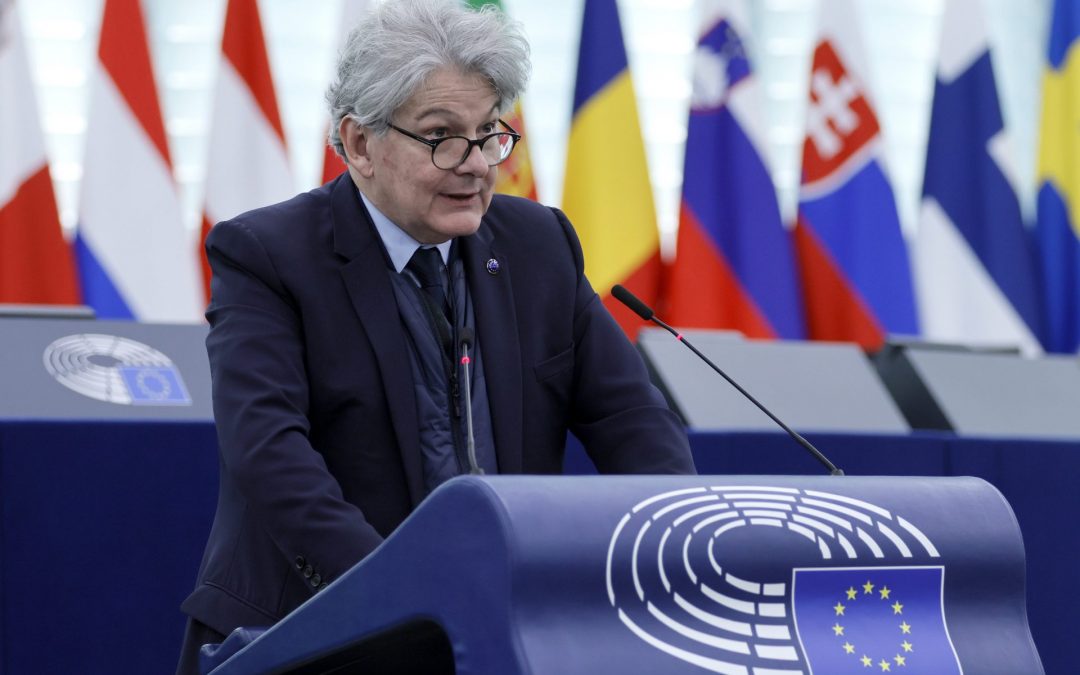
Brussels – In the first reaction to the decision of the U.S. State Department to ban him from traveling to the country, former EU Commissioner for the Internal Market Thierry Breton asked in a post on X whether this was “the return of McCarthy’s witch hunt,” alluding to the activities to “fight communism” in the U.S. by Republican Senator Joseph McCarthy in the 1950s, which were later assessed as unjustified and based on excessive accusations.
The State Department’s decision states that the entry ban to the U.S. for Breton and four other people from Europe is being introduced because of their “efforts to pressure American technology firms to censor or suppress American viewpoints.”
Breton is considered the author of the EU’s Digital Services Act (DSA), which, among other things, introduced strict rules for large technology companies regarding privacy protection, tackling disinformation, data collection and preventing hate speech online, which in the U.S. was assessed as an attempt to censor opinions and to restrict the American IT sector.
– As a reminder: 90 percent of the European Parliament – our democratically elected body – and all 27 member states unanimously voted for the Digital Services Act. To our American friends: Censorship is not where you think it is, Breton stated in his post on X.
The American decision was also met with a reaction from the French Foreign Minister, Jean-Noel Barrot, who “strongly condemned” the travel ban to the U.S. on his compatriot Breton and four other Europeans.
– The Digital Services Act was democratically adopted in Europe to ensure that what is illegal offline is illegal online as well. It absolutely has no extraterritorial reach and in no way concerns the U.S., Barrot stated in a post on X.
According to him, the peoples of Europe are free and sovereign and cannot allow the rules that govern their digital space to be imposed on them by others.
The ban was also “strongly condemned” by the European Commission, which announced that it had requested “clarification” from the U.S. regarding this decision.
– Freedom of expression is a fundamental right in Europe and a shared core value with the U.S. and the entire democratic world. The EU is an open, rules-based internal market, with a sovereign right to regulate economic activity in line with its democratic values and international obligations, the Commission pointed out.
According to it, the EU’s digital rules guarantee a safe, fair and level playing field for all companies and are applied fairly and without discrimination.
– We have requested clarification from the U.S. authorities and remain in dialogue. If necessary, we will respond quickly and decisively to defend our regulatory autonomy from unjustified measures, the European Commission added.
The reaction also emphasizes that it is essential for the EU to be able to protect its citizens from online threats, such as images of terrorism or child abuse.
– EU legislation does not censor, it is stressed in the statement of the European Commission.
The American decision was also condemned in a post on X by the Executive Vice-President of the EC for Technological Sovereignty, Security and Democracy and European Commissioner for Digital and Frontier Technologies Henna Virkkunen, who stressed that the EU’s digital rules were “democratically established by the European Parliament and the member states.”
Besides Breton, a travel ban to the U.S. has also been imposed on the Chief Executive Officer of the Center for Countering Digital Hate, Imran Ahmed, on the leaders of the German organization “HateAid,” Josefine Ballon and Anna-Lena von Hodenberg and on the head of the Global Disinformation Index (GDI), Clare Melford. (24 December 2025)