
 go to the original language article
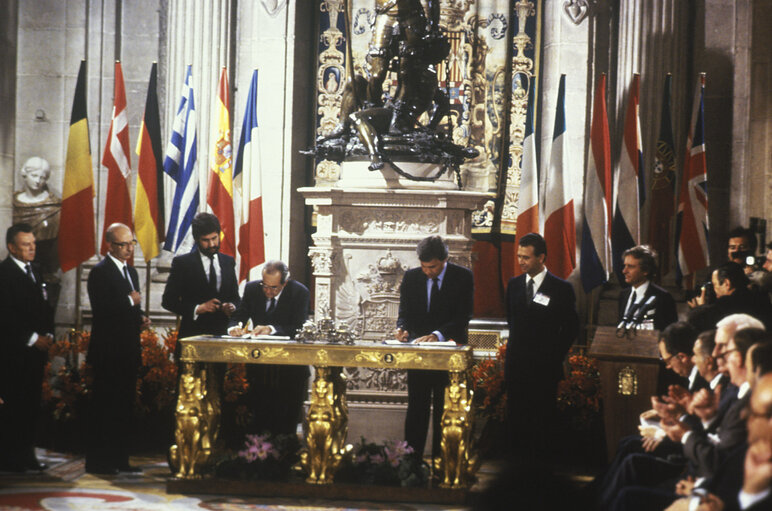
Madrid – On January 1, 1986, Spain finally joined what were then the European Communities, thus putting an end to decades of isolation during Franco’s dictatorship and opening a new phase of modernization and prosperity for the country. The 40 years that have passed have meant a great change for Spain, but Spain has also contributed during this time to the European project.
Below we review in ten facts what these four decades since accession to the EU have brought:
Five presidencies of the Council of the EU
Spain has held the presidency of the Council of the EU on five occasions. The Council is occupied on a rotating basis every six months by the different member states. The first time this occurred was in the first half of 1989 and the most recent in the second half of 2023. In between, Spain held the rotating presidency in the second half of 1995, in the first quarter of 2002 and in the first half of 2010.
Nine commissioners
Since joining the EU, Spain has contributed a total of nine names to the different Commissions that have followed one another since then. Initially, when there were fewer member states than the current 27, each country contributed two names, but since 2004, when the “big enlargement” took place, the figure was reduced to one.
The first to hold the post were Abel Matutes and Manuel Marín, who joined the Jacques Delors Commission in 1986 and remained in their positions until 1994, in the case of the latter even becoming its vice-president.
Marín continued as commissioner with the arrival of Jacques Santer to the presidency of the Commission in 1995 and became its president on an interim basis when he resigned in 1999, until Romano Prodi took over. In addition, during this period Marcelino Oreja also served as commissioner.
In the Prodi Commission (1999–2004) Spain’s representatives were Loyola de Palacio and Pedro Solbes, although the latter left the post in April 2004, which led to the arrival of Joaquín Almunia, who continued during the two terms of José Manuel Durao Barroso as president until 2014, holding the vice-presidency in the second of them and being in charge of Competition.
Next, Miguel Arias Cañete arrived in Brussels to join the Jean Claude Juncker Commission until 2019, when, with Ursula Von der Leyen at the helm, Josep Borrell took over, being appointed vice-president and High Representative for foreign policy. At present, Teresa Ribera is the Spanish representative, holding the vice-presidency and the Clean Transition portfolio.
60 MEPs
The number of Spanish representatives in the European Parliament has evolved over the years, at the same time as the number of seats has changed with the various enlargements. Thus, when Spain joined the EU it was allocated 61 MEPs, which rose to 64 in the 1999–2004 term.
With the 2004 enlargement, they were reduced to 54, a figure that remained unchanged until 2019, when they increased to 59 due to the United Kingdom’s departure from the EU. In the current term, Spain has 61 MEPs by virtue of the new distribution as a result of Brexit.
Three presidents of the European Parliament
In these 40 years, three Spaniards have held the Presidency of the European Parliament. The first to do so was the Socialist Enrique Barón Crespo between 1989 and 1992. After him, it was the turn of the People’s Party member José María Gil-Robles, between 1997 and 1999, while the last was the Socialist Josep Borrell, between 2004 and 2007.
More than 150 billion euros in cohesion funds
In these 40 years, Spain has received more than 150 billion euros in cohesion funds, that is, the aid provided by the EU to reduce the economic and territorial disparities of the member states.
This has translated, among other things, into the construction of public infrastructure — such as the 6.7 billion received since 2007 for high-speed rail infrastructure — the more than 7 million households that have gained access to broadband, or the nearly 150,000 companies that have benefited from these funds.
More than 350 billion from the European Social Fund
This fund is the main instrument with which the EU supports job creation, helps people obtain better jobs and guarantees fairer employment opportunities for all EU citizens. The funds received by Spain have reached more than 32 million people in this period, according to data from the State Public Employment Service.
GDP has doubled
The steady economic progress that Spain’s entry into the EU has brought, with access to the single market and, since 2002, to the euro, has allowed GDP to more than double in these 40 years.
Employment has also doubled
Accession brought with it new employment opportunities, which has meant that total employment has gone from 10.8 million jobs in 1986 to 21.1 million in 2024.
Increase in exports
The trade and preferential access agreements that the EU maintains with almost 80 countries — to which Mercosur could soon be added — have made it possible to increase Spain’s exports of goods. Thus, they have gone from 12.6 billion euros in 1986 (4.9% of GDP) to 141.5 billion euros in 2024 (8.9% of GDP).
More than 200,000 Erasmus students
More than 200,000 Spanish students have had the opportunity to pursue their studies in other EU member states thanks to the Erasmus program, created in 1987 and promoted by then commissioner Manuel Marín.
((All these data are part of the initiative ‘Since 1986. 40 years building Europe together’, a compilation prepared by the Representation of the European Commission in Spain and the Office of the European Parliament in Spain)) (December 30)