
 go to the original language article
SOFIA – Bulgaria has officially been the 21st member of the euro area since 1 January 2026 – 19 years after the country’s accession to the European Union (EU). This became possible after the Council of the EU voted unanimously on 8 July 2025 on the final decisions related to the adoption of the euro in Bulgaria. With this, the procedure was completed, after earlier the same day the European Parliament also approved by a large majority the report on the introduction of the single European currency by Bulgaria.
The Governor of the Bulgarian National Bank (BNB) becomes a member of the Governing Council of the European Central Bank (ECB) with voting rights, and the Bulgarian Minister of Finance joins the Eurogroup – the informal body in which the finance ministers of the countries whose currency is the euro participate.
I warmly welcome Bulgaria to the euro family and the Governor of the BNB Dimitar Radev to the table of the ECB Governing Council in Frankfurt, said Christine Lagarde, President of the ECB.
The introduction of the euro is the last milestone in Bulgaria’s integration into the European Union – a place that is due to us thanks to the achievements of our millennia-old culture and the civilizational contribution of our country, said the President of Bulgaria Rumen Radev in his New Year’s address.
For Bulgaria, 2026 is a turning point, because it marks the full membership of our country in the euro area, which will allow it to take its rightful place in the common European family, wrote the Speaker of the Bulgarian Parliament Raya Nazaryan on her Facebook profile.
We welcome the New 2026 Year as a member of the euro area – a strategic step that brings greater security, financial stability and more opportunities for citizens and for business, said the Bulgarian caretaker Prime Minister Rosen Zhelyazkov, in a post on the Facebook profile of the Council of Ministers.
I am happy that I had the opportunity to be part of the fulfillment of a dream for generations of Bulgarians, wrote the Bulgarian caretaker Minister of Finance Temenuzhka Petkova on Facebook.
In his address on the eve of 1 January, the Governor of the BNB Dimitar Radev stated that the euro is not just an economic decision and a currency, but “a sign of belonging: that your place is not on the periphery, but in a space of common rules, trust and responsibility; a sign that the effort you have made has been recognized and accepted.” “On the newest European coins it says ‘GOD SAVE BULGARIA’ and that says enough, because Bulgaria is Europe and Europe is Bulgaria,” emphasized the Governor of the BNB.
“Welcome to the euro, Bulgaria,” wrote the President of the European Parliament (EP) Roberta Metsola on her official page as head of the institution in English and Bulgarian.
The transition from lev to euro is more than a change of currency – it places Bulgaria in the heart of Europe, stated the European Commissioner for the Economy Valdis Dombrovskis. According to him, the country has made exceptional efforts to prepare for the euro, and Bulgarians can be proud of this achievement.
Bulgaria’s accession to the euro area is a turning point that reflects sustained efforts and reforms, strengthens our common currency and the shared economic foundations of the European Union at a decisive moment for Europe, said Kyriakos Pierrakakis, Minister of Finance of Greece and President of the Eurogroup, which brings together the finance ministers of the countries of the monetary union.
The European Central Bank will illuminate its main building in Frankfurt every evening until 11 January in honor of Bulgaria’s accession to the euro area, the institution announced on its website.
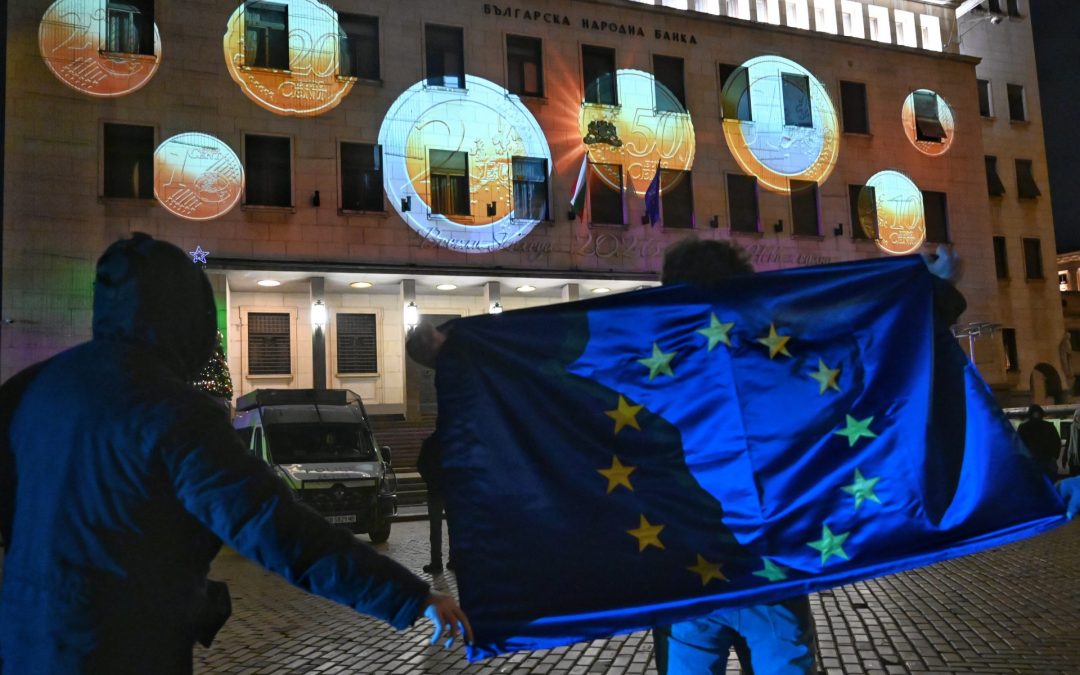
With a light show and 3D mapping on the BNB building on the night of 31 December 2025 to 1 January 2026, Sofia welcomed the euro.
Until the end of January, the lev will be an equivalent means of payment in Bulgaria, and from 1 February the euro will be the only currency, in accordance with the Law on the Introduction of the Euro in the Republic of Bulgaria. The lev-euro exchange rate is 1.95583 leva for 1 euro, corresponding to the central rate of the lev in the currency board. Until 8 August 2026, however, prices will continue to be displayed in dual form in euro and lev, according to the requirements of the law, in the same font, size and color. (1 January 2026)