
 go to the original language article
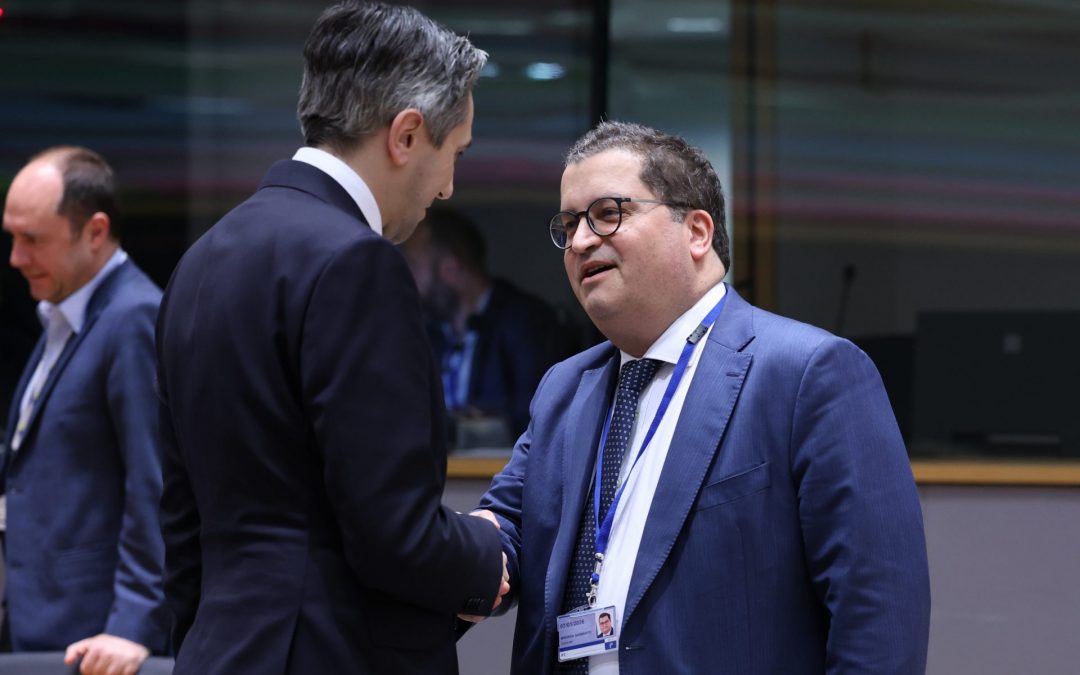
The Portuguese Government defended a “united and quite strong response” from the European Union (EU) to the threats by the US President, Donald Trump, to move forward with tariffs on some EU countries in opposition to control of Greenland by the United States.
“I will not anticipate the decisions that the European Council will make, at the level of prime ministers and heads of government, but it has to be a united response and a quite strong response because there are lines that cannot be crossed and the sovereignty of States is one of them,” said the Minister of Finance, Joaquim Miranda Sarmento, in Brussels.
“We are going to discuss this today and tomorrow [at the Eurogroup meeting today and at Ecofin on Tuesday] and there is a European Council on Thursday,” he added, speaking to Portuguese journalists on arrival at the meeting of euro area finance ministers, days after Trump threatened to move forward with tariffs of 10% and 25% on eight European countries, six of which are in the EU, in a context of tensions regarding the autonomous territory of Denmark, Greenland.
Joaquim Miranda Sarmento indicated that the EU is prepared “to act together, to assess the various options, given that this is a red line that the Union cannot fail to cross.”
The government official declined to specify possible approaches, stating only that “there are various instruments on the table,” one of them being an anti-coercion instrument, with countermeasures amounting to 93 billion euros.
“We are not going to anticipate solutions, but it is not possible to accept that, even more so from a country that is Europe’s ally in NATO, a country that with Europe has had the largest trade relations in the world, it could jeopardize the sovereignty of part of a Member State,” he listed.
The Minister of Finance guaranteed: “Portugal will always be on the side of compromise, of the majority solution and of the defense of Europe.”
When asked about the possible impact of US measures, Joaquim Miranda Sarmento pointed out that Portugal has a “more comfortable and more robust position to accommodate negative external shocks that may occur.”
An extraordinary European summit is scheduled for next Thursday, which was convened by the President of the European Council, António Costa, after Donald Trump stated that he intends to levy tariffs (of 10% in February and 25% in June) on goods from eight European countries due to opposition to United States control over Greenland, including six EU Member States (Denmark, Sweden, France, Germany, the Netherlands and Finland) and two others (Norway and the United Kingdom).
The high-level meeting of EU leaders takes place in a context of tensions over the autonomous Danish territory, which is the target of claims by the US President.
About a year ago, when he took office for a second term at the head of the White House, Donald Trump imposed tariffs on several territories, including the EU, but the threats were resolved through a trade agreement signed by Brussels and Washington last summer providing for a maximum limit of 15% in customs duties.
What is certain is that, in the face of last year’s trade tensions, the EU went so far as to outline a package of retaliatory tariffs of 93 billion euros on the United States, which is frozen until February, and the bloc may resort to this list if Trump’s new threats materialize.
Donald Trump has insisted for months that the United States must control Greenland, an autonomous territory of Denmark and a NATO member, considering that anything less than the Arctic island being in American hands would be unacceptable.
Greenland, a vast Arctic island with a population of 57,000 inhabitants, has significant mineral resources, most of which are still unexplored, in addition to a strategic location.