
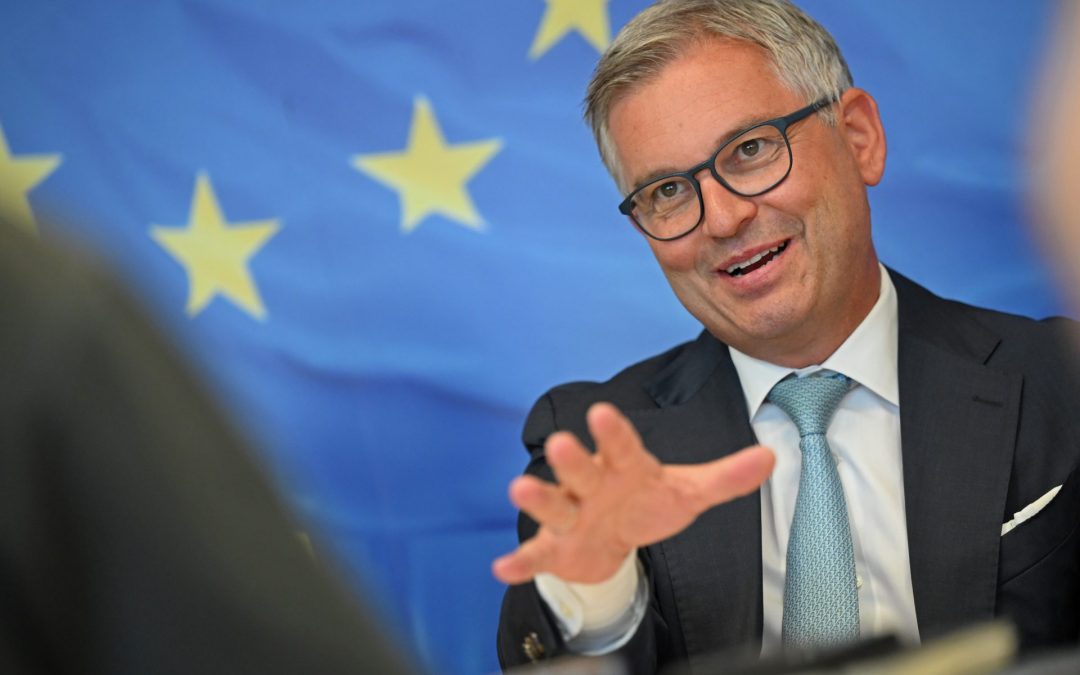
Brussels (enr) – The European Union’s migration commissioner has renewed his call for Germany to gradually end controls at its internal borders, pointing to falling numbers of irregular arrivals and the bloc’s new asylum rules.
It was now time to gradually abolish internal border controls, Magnus Brunner told members of the European Newsroom (enr) network in Brussels.
The Austrian commissioner said the EU’s external borders were better protected and that irregular crossings had fallen sharply. Frontex recorded about one-third fewer irregular crossings at the EU’s external borders in the first half of 2026 than in the same period last year.
The EU’s new Pact on Migration and Asylum also took effect on June 12. Brunner said member states had begun implementing the rules and that the bloc was already seeing progress.
He welcomed steps by individual countries to ease controls. Checks on the border between Germany and Luxembourg on the Trier motorway have been lifted, he said. He also cited the suspension of controls between Austria and Slovenia.
Germany has had checks at its land borders since September 2024. Former Interior Minister Nancy Faeser ordered them, and her successor, Alexander Dobrindt, intensified them in May 2025. Dobrindt has repeatedly extended the measures, which are currently due to remain in place until September.
Brunner also defended the EU’s new Entry/Exit System, known as EES. The digital system records the entry and departure of travellers from outside the EU, Iceland, Liechtenstein, Norway and Switzerland.
He acknowledged that the system had caused problems at some airports, including in Greece and Portugal, but said: “The system itself works very, very well.”
The system has faced criticism over long queues. The Airports Council International Europe has reported waiting times of up to five hours and missed connecting flights.
Brunner said professional truck drivers from the Western Balkans faced a particular problem because they can currently stay in the EU for no more than 90 days in any 180-day period. He proposed that EU member states and Western Balkan countries negotiate long-term visas on a bilateral basis.