
 go to the original language article
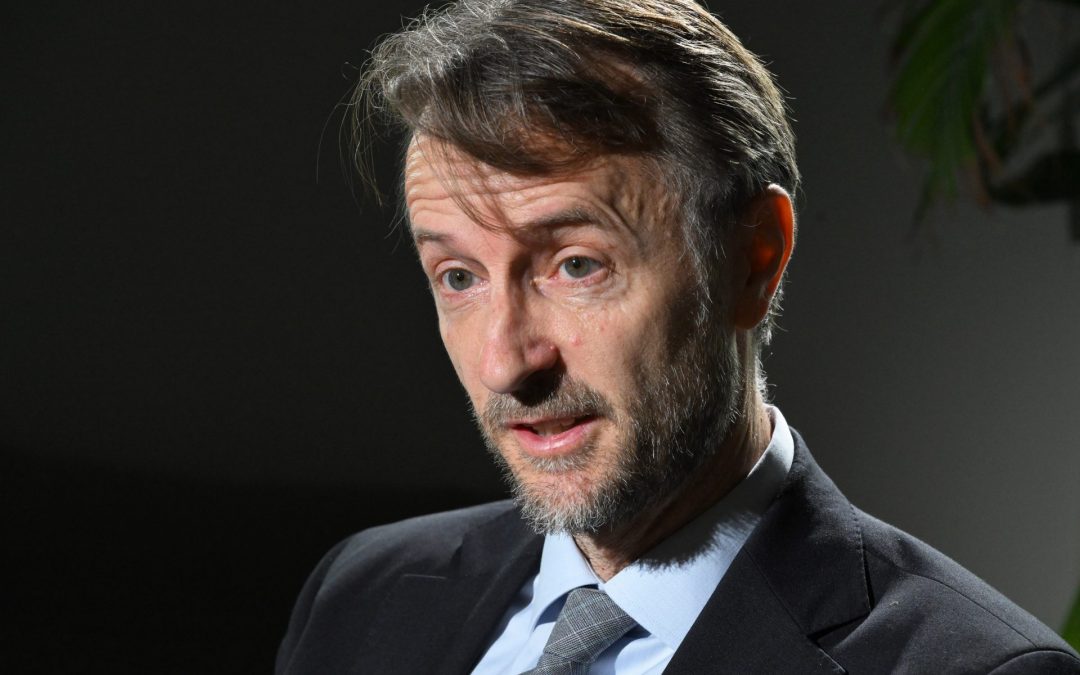
BELGRADE – The Head of the Delegation of the European Union to Serbia, Andreas von Bekerat, assessed as important the fact that in the statement of the President of Serbia, Aleksandar Vučić, who announced that he would not attend the EU – Western Balkans Summit, the message was clearly emphasized that Serbia will continue on the European path as long as he is president.
Bekerat added that the EU’s wish was for Vučić to be in Brussels at the Summit. “I carefully took note of President Vučić’s comments last night. And, of course, we would have liked to see President Vučić at the meeting in Brussels. But I think that what really remained with me as the key message from his comments was his very, very clear emphasis on the fact that, as long as he is president, Serbia will continue on the path toward the European Union,” said the head of the EU delegation in Serbia.
Bekerat stated this at the annual international conference “Strategic Flows” dedicated to the European Political Community, its place in the contemporary European strategic architecture and its importance for the countries of the region, organized by the Forum for Strategic Studies at the European House. He emphasized that he very much welcomes the strong commitment of President Vučić and the Chair of the Parliamentary Committee for European Integration, Elvira Kovač, when it comes to Serbia’s accession process to the European Union. “Now I really expect this commitment to be translated into concrete activities when it comes to implementing reforms,” he said. Speaking about Cluster 3, which Serbia expects to open, Bekerat recalled that the European Commission had already confirmed in 2021 that Serbia had met the technical conditions, but that the decision is now up to the member states and that on Tuesday they were not in a position to agree on it. He said that they will return to this issue again next year and added that progress in the area of the rule of law and fundamental rights would significantly help member states to more easily make a positive decision on opening Cluster 3.
As he said, as stated in the negotiating framework between Serbia and the EU, the dynamics of the accession process will be based on and determined primarily by reforms in the area of the rule of law and fundamental rights, but also by progress in the normalization of relations with Priština. When it comes to reforms, in line with the annual report presented earlier this year, he said, they are looking forward with great interest to an acceleration of reforms in all areas, but especially in the area of the rule of law and fundamental rights, including the independence of the judiciary, the autonomy of the prosecution, and electoral reforms. He added that the annual report stated that there had been a standstill in the area of the rule of law and fundamental rights and that this is precisely why it is of exceptional importance to see an acceleration of reforms in these areas. (December 17-)