
 go to the original language article
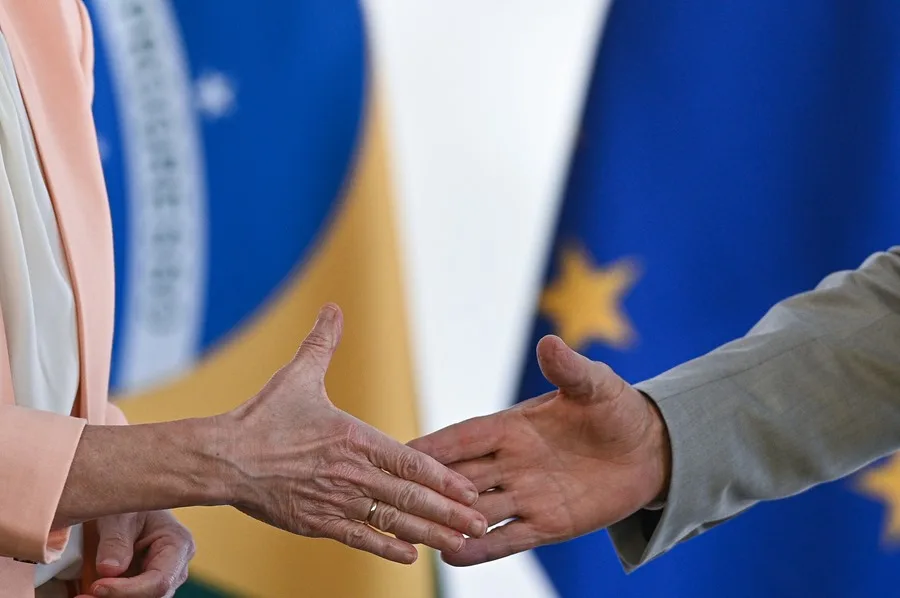
Vienna (APA) – The growth effects of the EU-Mercosur trade agreement for the European economy are likely to be rather small. That is the conclusion reached by two experts with whom APA – Austria Presse Agentur spoke on Monday. From the economists’ point of view, however, the agreement is still positive. The FPÖ, meanwhile, on Monday criticized possible effects of the agreement on female and male farmers and targeted the ÖVP Farmers’ Association.
Various studies on the EU free trade agreement with the Mercosur countries Brazil, Argentina, Paraguay, Uruguay and Bolivia have come to the conclusion that EU economic output (gross domestic product; GDP) will be around 0.05 percent higher in ten years than without the agreement. For the Mercosur area, an increase of an average of 0.25 percent is expected, explained IHS economist Klaus Weyerstrass in an interview with APA.
Last week, after more than 25 years of negotiations, a breakthrough was achieved in the trade agreement. The EU ambassadors voted by a majority in favor of signing the agreement. Austria was bound to a no by a parliamentary resolution.
Rare earths in focus
It is less the economic potential and more geostrategic arguments that speak in favor of the agreement, said Weyerstrass with a view to the (tariff) policy of US President Donald Trump and the competition with China. The economist pointed to the deposits of rare earths in South America that are needed for economic transformation. “On the other hand, if we diversify there, we will be less dependent on and less susceptible to blackmail by China.”
He is not very worried about European agriculture, whose interests – especially given its small share of total value creation – have been strongly taken into account in the agreement. “The high standards in the EU still apply; they are not being abolished. Everything in terms of food that is imported into the EU must, of course, still meet the standards applicable in the EU.”
“Idea that both benefit”
Many exceptions and quotas for agricultural products were negotiated into the agreement, said Wifo economist Harald Oberhofer. “Trade agreements are based on the idea that both sides should benefit.” If industry in Europe is to benefit from exports, the Mercosur states must also benefit. Sensitive areas, such as beef, are also strongly protected in the agreement. Oberhofer does not expect any strong impact on domestic farmers here. For other agricultural products, however, stronger price effects can be expected.
FPÖ calls for mandatory indication of origin
There was once again strong criticism of the planned EU-Mercosur agreement from the FPÖ. The approval (by a majority) of the EU member states for the agreement is “a drama”, said the deputy FPÖ spokesperson for agriculture and forestry Albert Royer at a press conference on Monday. He called for mandatory indication of origin for food. Royer strongly criticized the ÖVP and the Farmers’ Association close to it. He accused the ÖVP of behaving differently at EU level than it presents itself to domestic farmers. (12.1.2026)