 go to the original language article
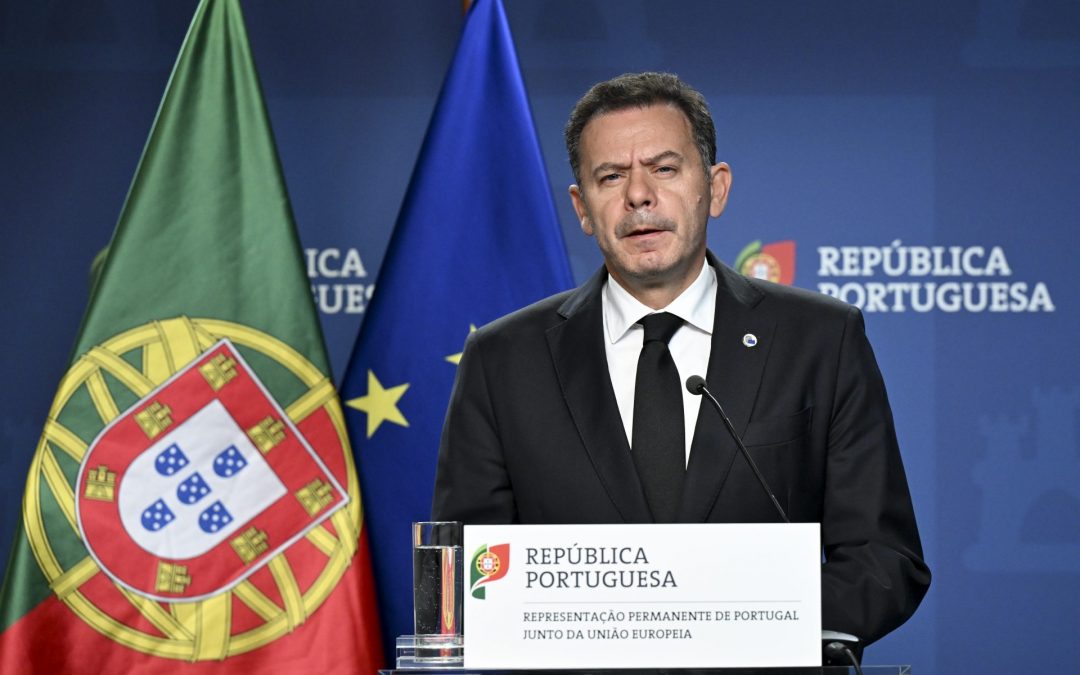
The Prime Minister, Luís Montenegro, said today that “the strength of Europe and European solidarity are being put to the test” at the European summit in Brussels, at which the leaders of the European Union (EU) will decide on financial support for Ukraine until 2027.
“I would say it is one of the most decisive [European] Councils held in recent years. I believe this is really the time to say that the strength of Europe and European solidarity are being put to the test today and, from our point of view, Europe cannot, must not fail and our conviction is that the meeting will be tough, it will be intense, but it is possible for us to reach an understanding,” said Luís Montenegro, on arrival at the European summit in Brussels.
“We are being put to the test, this must be acknowledged,” reinforced the head of Government, describing as “absurd” the accusations of the US President, Donald Trump, who called European leaders weak.
The EU leaders, meeting today in Brussels, will discuss financial support for Ukraine in 2026 and 2027, deciding whether to approve a reparations loan based on immobilized Russian assets, rejected by Belgium.
For Portugal, according to Luís Montenegro, “the ideal solution is the use of frozen Russian assets,” although the country is “open to other solutions or even to combining more than one solution,” in an allusion to the other proposed initiative, related to joint debt.
The head of Government concluded that “this is not one of those European Councils where things are guaranteed and dealt with in advance,” but rather a summit “that starts now, but no one knows when it will end.”
In one of the most important meetings of the European Council, given the urgency of securing funds in favor of Ukraine for the next two years, the heads of Government and State of the 27 EU countries will try to reach a political agreement on one of the options on the table: a reparations loan based on Russian assets frozen in the EU (the option that requires the most support, a qualified majority and less budgetary effort, despite Belgian opposition) or a joint debt issuance (which is not supported by everyone and requires unanimity).
At the moment, talks are underway in the EU to unblock options for European financing for the country invaded by Russia in February 2022.
The measure that has the most support in the EU concerns a reparations loan to Ukraine, but it faces opposition from Belgium, the country that hosts most of the frozen Russian assets through Euroclear, a securities depository institution based in Brussels that holds 185 billion euros of the total 210 billion euros of frozen assets in Europe.
The Belgian government demands guarantees and clear commitments from the other Member States to protect itself legally, as it does not want to take the risk of being left without the funds if Russia does not pay reparations.
The reparations loan would mean that the European executive would take out loans from European financial institutions that hold immobilized balances of assets of the Central Bank of Russia, thus being a credit based on Russian assets immobilized in the EU due to the European sanctions applied to Moscow for the invasion of Ukraine.
Portugal would be responsible for budgetary guarantees of 3.3 billion euros.
The other proposal is a joint debt issuance to raise money for Ukraine, using budgetary margin as a guarantee for Brussels to go to the markets, but it requires the approval of the 27 Member States (and not just a qualified majority, as in the previous case).
The International Monetary Fund estimates that Ukraine’s needs for the next two years are around 137 billion euros, with the EU wanting to cover nearly two-thirds of that amount.
Europe’s strength and solidarity put to the test today in Brussels – PM
EU leaders will discuss financial support for Ukraine in 2026 and 2027