
 go to the original language article
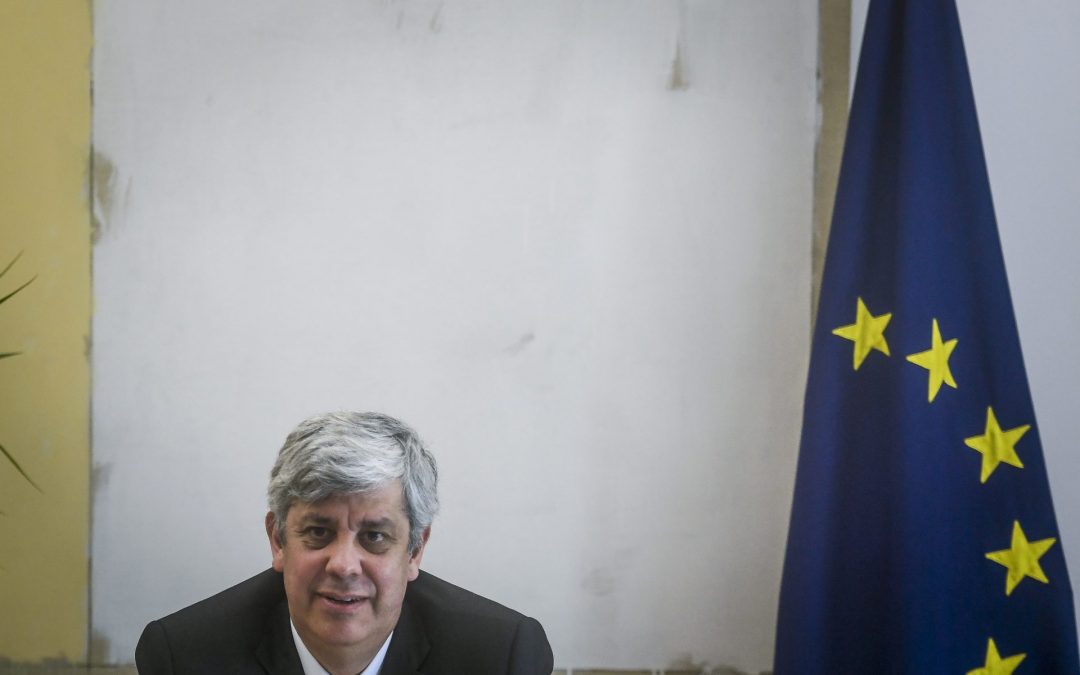
The Minister of Finance spoke of a “difficult election” for the vice-presidency of the European Central Bank (ECB), for which the former governor of the Bank of Portugal and former minister Mário Centeno is running today in Brussels, while nevertheless indicating he maintains “some hope”.
“This is a difficult election. First, it is a difficult election because of the rules themselves, because what is on the table is a reinforced qualified majority and there are six candidates and, therefore, it is natural that at this meeting there may be several rounds until a candidate is eventually found who meets these requirements,” said Joaquim Miranda Sarmento, speaking on arrival at the Eurogroup meeting in Brussels, at which the successor to Luis de Guindos as ECB vice-president from June will be decided.
This will also be a “difficult election” for the former governor of the Bank of Portugal and candidate supported by the Government, Mário Centeno, since the current ‘vice’ is “a Spaniard, before that it was a Portuguese, before that it was a Greek and there are naturally regional balances with the Eastern countries, with the Baltic countries that need to be taken into account,” added Joaquim Miranda Sarmento.
Even so, he said he had “some hope”.
“We submitted the candidacy of Dr. Mário Centeno following the expression of availability that he gave. […] We always support Portuguese when they have the possibility of running for an international or European position,” he said.
Indicating that he had carried out “a set of diplomatic efforts” with other countries, Joaquim Miranda Sarmento added that “if Dr. Centeno did not have the curriculum for the position, the candidacy would not even have been submitted”.
The Eurogroup is voting today on the candidacy of the former governor of the Bank of Portugal, Mário Centeno, and five others for the ECB vice-presidency, to replace Luis de Guindos, who leaves at the end of May.
The vote is on six candidacies: that of the former governor of the Bank of Portugal and former Minister of Finance, Mário Centeno; the governor of the central bank of Latvia, Mārtiņš Kazāks; the governor of the central bank of Estonia, Madis Müller; the governor of the central bank of Finland and former European Commissioner for Economic and Monetary Affairs, Olli Rehn; the former Minister of Finance of Lithuania, Rimantas Šadžius; and the governor of the central bank of Croatia, Boris Vujčić.
The chosen candidate must secure the support of 72% of the Member States of the single currency area (that is, at least 16 of the 21 euro countries), representing at least 65% of the population.
Following the Eurogroup discussion, the Council of the European Union will adopt a recommendation to the European Council (at leaders’ level), deciding by reinforced qualified majority of the euro countries.
In accordance with the selection process, after these steps are taken, the ECB and the European Parliament will be consulted before the European Council takes a final decision.
The Portuguese Government decided to formally submit the candidacy of Mário Centeno for ECB vice-president, following a request from him.
The vote is expected to start at 17:00 (local time, one hour less in Lisbon) and, according to European sources heard by Lusa, may not be concluded today.
At 59, Mário Centeno was, between mid-2020 and mid-2025, governor of the Bank of Portugal, after having served as Portuguese Minister of Finance between 2015 and 2020. It was in those functions that he became president of the Eurogroup, the informal single currency forum, between 2018 and 2020.