
 go to the original language article
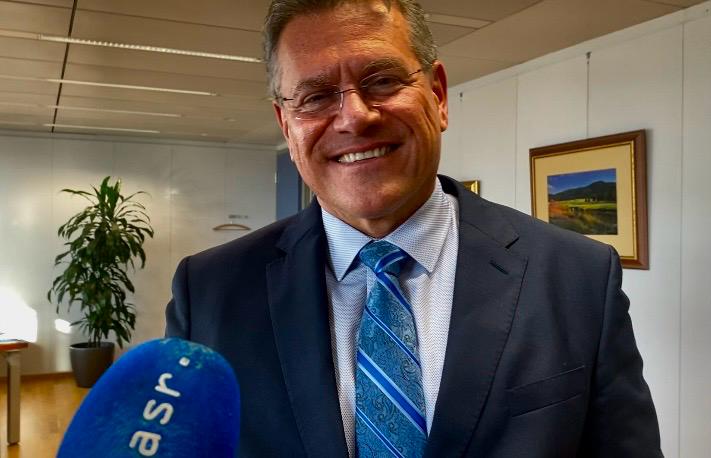
Brussels – At the beginning of 2026, the EU free trade agreement with the Mercosur association countries should be signed. The European Commission (EC) wants to conclude a similar agreement with India and present a deep reform of the customs union. During the year, it will focus on trade negotiations with partners from Asia and the Pacific. This was stated by European Commissioner for Trade and Economic Security Maroš Šefčovič during a meeting with Slovak journalists in Brussels, reports the TASR correspondent.
Maroš Šefčovič considers the signing of the agreement with Mercosur, the largest trade agreement the EU has ever signed, to be the most important thing at the beginning of the year. He pointed out that it is four times larger than the agreement with Japan.
“We are talking about exclusive access to critical minerals, about great opportunities for the engineering and agricultural industries, where rates are often reduced from more than 40 percent to zero,” he said.
He expressed hope that in January the EC will manage to complete two major things – negotiations on a free trade agreement with India and a deep reform of the customs union, the largest reform since 1969. “We want to use digital forms, joint assessment of data from customs reports so that we can guarantee EU citizens that what they receive in parcels, or what is sent to the European market, meets all our requirements and that it is safe,” he explained.
According to him, the most advanced now is the free trade agreement with India. “A kind of milestone for us is the end of January. The EU should be the official guest at India’s National Day. It would be a great opportunity to conclude this agreement, even though it is very complicated. We still have big gaps between us in what we would like to achieve,” said the Slovak European Commissioner.
At the same time, he confirmed that the EC is moving forward on a “breakthrough” trade agreement with the United Arab Emirates. It is called breakthrough because if all the complexities associated with the agreement are resolved, it will open the way for accelerated negotiations on a regional trade agreement with all the Gulf countries.
“Over the next two years, we would like to conclude free trade negotiations with the Philippines, Thailand and Malaysia. This would cover most members of the Association of Southeast Asian Nations, ASEAN,” he said.
Šefčovič considers the establishment of a strategic partnership with the Pacific countries to be a new element in the EU’s trade policy. This is an association of 12 countries in the Pacific region, to which the United Kingdom has joined. “Together with us, we would represent 30 percent of the world’s gross domestic product and up to 30 percent of world trade. So this is an enormous force that will certainly be important in how the framework for future trade policy will be created, how the World Trade Organization will be reformed and, of course, it also opens up new opportunities for our entrepreneurs and exporters,” Šefčovič described the EU’s main trade priorities for the future. (5 January)