
 go to the original language article
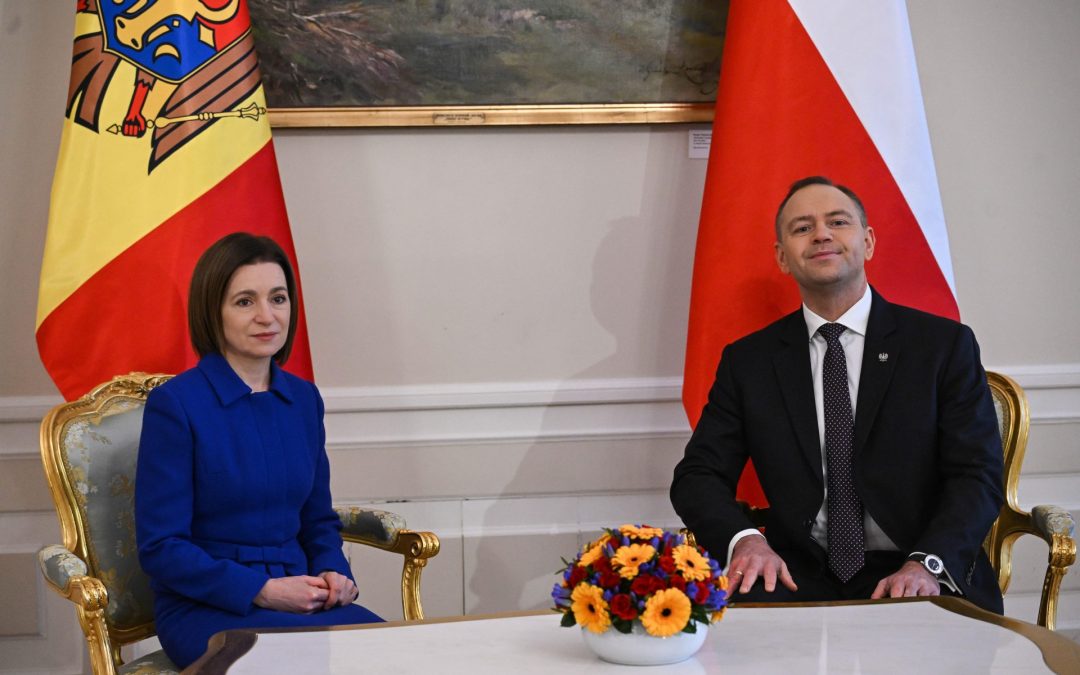
Poland continuously supports Moldova on its path to membership in the European Union, said President Karol Nawrocki after a meeting with the President of Moldova. Maia Sandu, thanking Poland for being Chișinău’s advocate in Europe, emphasized that her country wants, among other things, to attract more Polish investments.
During her official visit to Warsaw on Monday, the President of Moldova, after meeting with President Nawrocki, also spoke with Prime Minister Donald Tusk, Speaker of the Sejm Włodzimierz Czarzasty and Speaker of the Senate Małgorzata Kidawa-Błońska.
During statements to the media after the meeting, President Nawrocki said that Poland is pleased with the direction chosen by Moldova in leaving the Russian sphere of influence. He also assured that Poland – both the president and the government – supports Moldova on its path to the European Union and in its reforms. He assured that “this will not change.”
President Nawrocki reported that he and President Sandu discussed security issues, as well as education and memory policy. He stressed that in these areas Poland offers Moldova the support of its experts.
“President Sandu received an assurance of such support today. We will cooperate. Thanks to the Institute of National Remembrance, Poland is becoming something of a model for how to conduct a sovereign historical narrative, how to tell the truth about Soviet crimes and about Soviet mechanisms which in the 21st century are also part of the Russian Federation,” said Nawrocki. He also reported that he had decided to send to Moldova an economic mission and a mission concerning national memory and history.
“We touched on the past, but we are thinking about our future around the ideas that unite both nations – sovereignty, independence and the direction of Western civilization,” said Nawrocki.
Referring to the recent parliamentary elections, in which the pro-European PAS party supported by Sandu won, defeating, among others, pro-Russian forces, Nawrocki said that in Moldova “democracy has been successfully defended,” and that “the long and brave struggle to break away from the Russian sphere of influence has our full support.” The talks also concerned bilateral economic relations, including Polish investments in Moldova, among others in the wine sector.
In addition, relations with the United States were also discussed. “In fact, this transatlantic alliance between European countries, between Poland and the United States, is a guarantee of peace and security throughout Europe,” declared President Nawrocki.
The President of Moldova stressed that when Russia attacked Ukraine, her country was entirely dependent on Russian gas. She admitted that now – thanks to support from, among others, Poland – Moldova has been able to give up trade with the country of Władimir Putin. As she pointed out, Moldovan institutions, media and citizens also stood up to Moscow, which tried to interfere in the course of the 2025 parliamentary elections. Sandu reported that, according to Moldovan assessments, Russia spent the equivalent of about 2 percent of Moldova’s GDP on attempts to interfere in the parliamentary elections in Moldova last year.
Sandu also pointed out that “the European Union report recognized that last year Moldova made the greatest progress among all candidate countries.” “For us, accession to the European Union is the clearest guarantee of security, democracy and freedom, while Poland is a constant, trustworthy advocate of Moldova in the European Union,” she said, emphasizing that her country is accelerating the reforms necessary for accession to the European Union and strengthening its institutions.
“Moldova is fully committed to this process. We believe in the European project and we want to contribute to it,” declared Sandu. She also pointed out that the key issue now is building the state’s resilience and counteracting hybrid attacks from Russia; she also thanked Poland for the support it provides her country in this area.
The President of Moldova also drew attention to issues of history and memory policy. She declared that Moldova “wants to learn from Poland’s experience” in this area. As she said, in Moldova the work of the Polish Institute of National Remembrance is known and appreciated, as is the past of Nawrocki as the head of this institution.
She assured that Moldova treats Poland’s support not only as a sign of friendship, but also as a foundation on which cooperation between the two countries can be expanded. “Moldova wants to increase trade with Poland and attract more Polish investments in agriculture, industrial sectors, IT, construction and the digital economy,” she added. “Moldova is proud to be able to stand alongside Poland,” she declared.
On Monday afternoon, Maia Sandu met with Prime Minister Tusk. “We discussed Moldova’s accession to the European Union, regional security, stronger trade ties and ways to create greater economic opportunities for our countries. Poland’s experience and support are of great importance for Moldova’s future in Europe,” Sandu later wrote in a post on X.
The President of Moldova also visited the Sejm and the Senate. In a post on X, she summed up that she had held “fruitful discussions with the speakers of both legislative chambers of Poland.” “Parliamentary cooperation is essential for reforms, accession to the European Union and strengthening democratic institutions. Moldova values Poland’s support and experience,” wrote Sandu.
The Chancellery of the Senate reported that the main topic of Speaker Kidawa-Błońska’s meeting with the President of Moldova “was security in the region, including the war in Ukraine and Russia’s hybrid and disinformation activities in Europe.” The Speaker of the Senate expressed full support for Moldova’s European aspirations. The Speaker of the Sejm, Włodzimierz Czarzasty, also assured President Sandu that Poland would support Moldova on its path to the European Union. As the Chancellery of the Sejm reported, their conversation also concerned the war in Ukraine and threats from Russia.
Representatives of the Moldovan government were also present in Warsaw. Among those who came to Poland was Minister of National Defense Anatolie Nosatîi, who met with Deputy Prime Minister and head of the Ministry of National Defense Władysław Kosiniak-Kamysz. The head of the Polish defense ministry later wrote on X that the topics of the talks were “hybrid threats from Russia, regional security and issues related to the war in Ukraine, as well as bilateral military cooperation.”
Minister of Culture Crisitan Jardan also met with his counterpart. Representatives of the Ministry of Culture and National Heritage wrote on X that “during the conversation, they summarized the cultural events which, during the Polish presidency of the Council of the European Union in 2025, were organized in Moldova.”
Maia Sandu has held the office of President of Moldova since 2020 and is regarded as the leader of the pro-European forces in the country. In 2024 she was elected for another term, and last year her Party of Action and Solidarity (PAS) won the parliamentary elections, defeating the pro-Russian opposition.
For years, Poland has expressed support for Moldova’s pro-European aspirations. In August last year, before the parliamentary elections in that country, Prime Minister Tusk, together with French President Emmanuel Macron and German Chancellor Friedrich Merz, visited Chișinău to express support for Moldova in its efforts to join the European Union. (26.01.26)