
 go to the original language article
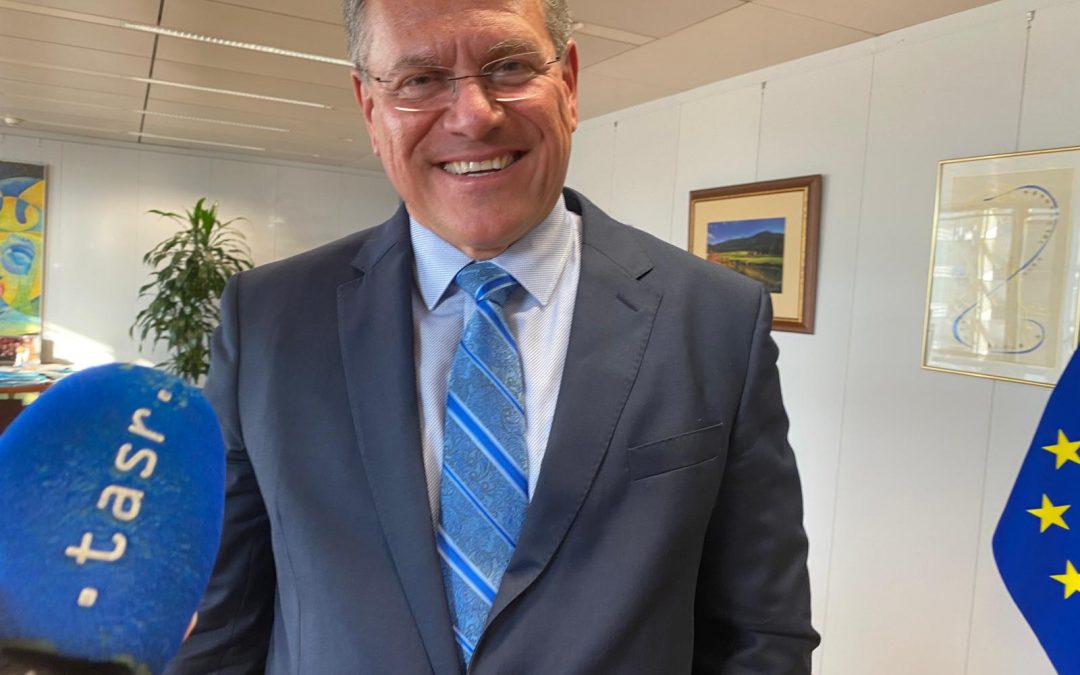
Brussels – Managing the European Union’s (EU) trade policy in 2025 was the biggest challenge he had to face in his professional life. This was stated by the European Commissioner for Trade and Economic Security Maroš Šefčovič during a meeting with Slovak journalists in Brussels, at which he evaluated his past working year, the TASR correspondent reports.
Maroš Šefčovič recalled that the world of trade has “completely changed” since last year and the EU had to deal with three fundamental problems – how to stabilize and calm relations with the USA, how to respond to the increasingly assertive policy from China, and how to make use of the renewed, even “dramatically increased interest” of the rest of the world in concluding trade agreements with Europeans.
“Not only we, but also our partners are going through similar situations. They appreciate that Europe is a predictable partner that signs agreements beneficial for both sides,” he explained.
According to him, in 2025 the view of the European Commission (EC) and the EU on economic security changed “dramatically”. On how more mutually beneficial free trade agreements are needed. “In this effort I think we have succeeded. I am very glad that we managed to conclude free trade agreements with the Mercosur countries, as well as with Indonesia. We were able to stabilize relations with important political and trade partners such as the United Kingdom and Switzerland, and we moved into the final phase of negotiations with India, but also with other countries from Southeast Asia, from ASEAN,” he added.
He claims that even though the Union is more exposed to the economic impacts of the war in Ukraine and despite all this year’s turbulence, the European economy has confirmed its resilience.
The most closely watched was certainly the EU customs and trade agreement with the United States
Šefčovič admitted that the most closely watched was certainly the customs agreement with the United States, which for him meant hundreds of hours of negotiations with the Americans.
“The USA was and is our largest trading partner. Every move on the other side of the Atlantic has an impact on the situation in Europe,” he said. He specified that his goal during the negotiations with the USA was how to make the best possible use of the transatlantic dimension of mutual trade, which represents 20% of all EU trade exchanges.
“Behind this I see factories, jobs, I see concrete people behind it. I think that thanks to that agreement from July we managed to a large extent to calm and stabilize our trade relations with the USA. I do not hide that there are many areas where I hoped we would be further along by now. I am talking mainly about high tariffs on steel and steel products, on agricultural production, for example the export of wine or alcoholic products. And many other areas that are important for Europe as export commodities. I hope that next year we will manage to achieve better results,” he said.
The Commissioner is aware of the amount of criticism directed at the EU-US agreement, and therefore points out that if the agreement had not been reached, a trade war with the USA would have had negative consequences for the European economy and for jobs.
“This was a choice we had to make. I am aware of a certain asymmetry of this agreement, that it is a demanding day-to-day management of this largest trade relationship we have on the planet, and that in the future it will require great effort. I am convinced that it is better to avoid sharp trade conflicts, to look for opportunities for cooperation, for example in the joint acquisition of critical raw materials for industry, in finding common approaches in the fight against overproduction, which is destroying the economy in the USA and in Europe. I believe that these will be the topics we will deal with next year,” he described the situation. (29 December)