
 go to the original language article
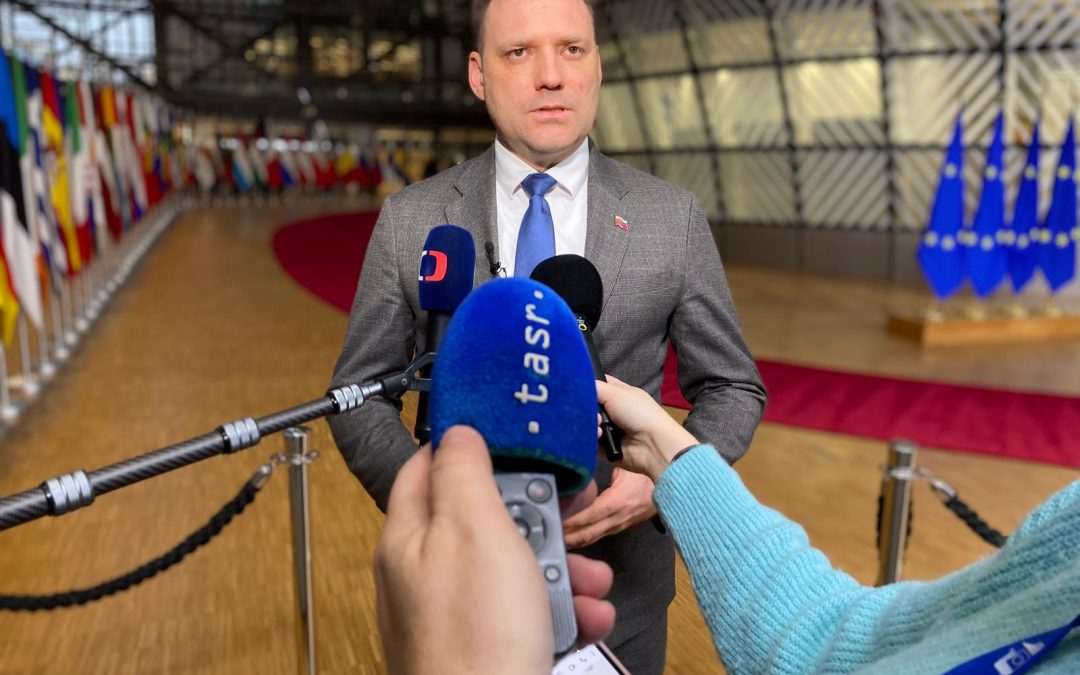
Brussels (TASR) – Slovakia does not consider the concessions in the area of ETS 2 emission allowances to be sufficient. Slovak Environment Minister Tomáš Taraba (nominated by SNS) stated this in Brussels on Tuesday after the conclusion of the EU Environment Council negotiations, TASR’s correspondent reports.
The EU emissions trading system, which from 2027 should be extended to heating of buildings and road transport (ETS 2), was the most important component of the negotiations at the Council of Ministers, said Tomáš Taraba. He recalled that although the European Commission (EC) indicated a postponement of the entry into force of ETS 2, Slovakia does not consider these concessions sufficient.
“We do not believe that the declared effort to release larger volumes of emission allowances onto the market will ensure any stabilization of prices in the future. The position of us, but also of Hungary and the Czech Republic and other countries, is that we have declared the intention to pull out of ETS 2,” he said. He added that other states, including Poland, claim that the mechanism proposed by the EC is questionable as to whether it will sufficiently ensure price stabilization. He also stressed that the benefit of ETS 2 for the environment is “negligible”.
We consider ETS 2 to be an extremely antisocial element that only makes people’s existence and housing more expensive
“We consider it to be an extremely antisocial element that only makes people’s existence and housing more expensive. It will also create pressure on prices as far as goods are concerned, because everything that will be transported on roads will essentially be exposed to some kind of price shock that no one today can estimate,” he described the situation. He expressed the view that claims that the EU has found a model to cap prices after the introduction of ETS 2 are not based on truth.
Taraba stated that after the formation of the new Czech government, the Czech Republic and Slovakia represent a “strong tandem” in the EU Council, because the two countries, among other things, share a possible vulnerability of their industry. He added that before the Council of Ministers there was a bilateral meeting of the Czech and Slovak delegations.
In this context, Taraba recalled that he is among the “extreme skeptics” towards the Green Deal and believes that the new Czech government is sending the same signal. “Right now we are closest to each other, because the Green Deal is destroying European industry and that should concern us in the Czech Republic and Slovakia, because we are the most industrialized states per capita,” he explained.
On Tuesday Taraba also had a meeting at the European Commission, where he addressed the restoration of aluminum production in central Slovakia, the cleanest aluminum plant in Europe, which produced almost one-fifth of European aluminum and had to be closed due to high energy prices. “Today we are talking about restoring the arms industry in Europe. What are we going to do it with when we have driven out all industry? Factories are sounding the alarm and I see nothing wrong with Slovakia and the Czech Republic communicating intensively in this regard,” he said. (16 December)