
 go to the original language article
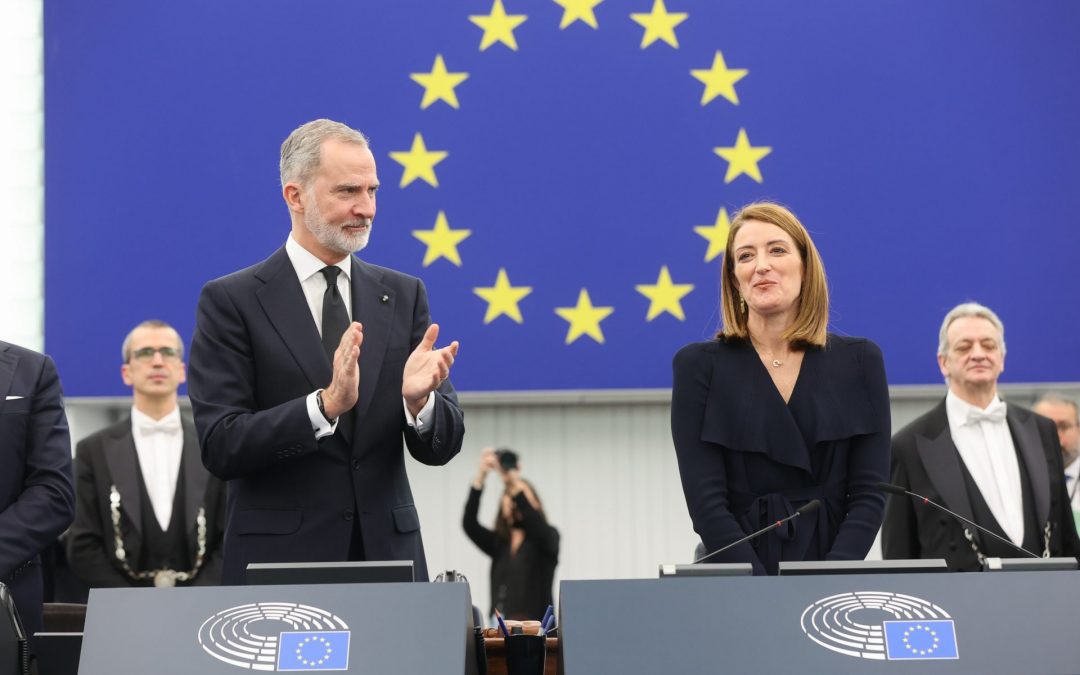
STRASBOURG – King Felipe VI took advantage of his address to the European Parliament on Wednesday to call for not accepting or endorsing “geopolitical approaches from another era” and to recall that “any phenomenon that affects one part of this space” affects the whole. In his view, the “strength” of the European Union is its “unity” and, in these “dark” and “turbulent” times, we must defend solutions “based on rules and dialogue” and “preserve the transatlantic bond” because without it, he warned, there will be “a more uncertain, more unstable and more dangerous world.”
He said this before the plenary of the European Parliament in Strasbourg, where he delivered a speech to mark the fortieth anniversary of the formal accession of Spain and Portugal to the European Communities.
The head of state stressed that “there is no citizenship without full awareness that we inhabit the same political space, and that any phenomenon that affects one part of that space is affecting us all.” At no point did he mention the president of the United States, Donald Trump, or his intentions regarding Greenland, but the attitude of the American leader was indirectly present throughout his address.
Europe “cannot be taken for granted”
“Our strength is our unity: how important it is, in these times, to remember that,” Felipe VI emphasized, while underlining that “the situation Europe is going through demands the commitment of everyone” and that Europe – the European Union – cannot be “taken for granted.”
According to the King, “never, as in these dark times, has the idea of Europe been so necessary.” “This Europe is the one that, in turbulent days, remains an ethical and political benchmark,” he asserted, before praising how this region of the world has “so deeply rooted” and “incorporated into its being” the “notion of the common good.”
He also stressed that in foreign policy, Europe defends “solutions based on rules and dialogue as a way to resolve conflicts and promote peace, stability and cooperation” and “cannot accept, much less endorse, geopolitical approaches from another era as if they were signs of a new time.”
Power without principles is equivalent to barbarism
“Ladies and gentlemen, the times we are living in remind us, all too often, that power without principles is equivalent to barbarism and that mere principles, without actions to back them up, lead to frustration and disenchantment,” the King warned.
In this context, he called for continued work on the defense and strategic autonomy of Europe and on the “strengthening of the European pillar within the Atlantic Alliance,” which he considers an “unpostponable necessity” and, at the same time, “the best way to preserve a transatlantic bond based on respect and loyalty that has given so much to all of us.” “Without that bond we will be doomed to a more uncertain, more unstable and more dangerous world,” the head of state cautioned.
That is why he called for “boldness,” also in domestic policies to avoid “bureaucracy and regulatory excess.” “Let us face the challenge of productivity, of innovation, of AI (artificial intelligence). The pandemic proved what we can do when we work together, when we make use of the strengths of each member state. I said it, a few months ago, at the closing of the academic year of the College of Europe: ‘Let no one underestimate the capacity of Europeans to respond to their challenges,’” he concluded.
The “threat” of “forgetfulness”
Felipe VI acknowledged that European citizens tend to be “very critical” of the EU institutions and that it is not “unusual” to hear comments about “the weakness of a united Europe, its outdated idealism” or “its disconnection from reality.” And although he believes that criticism is a sign that democracy is working, he warned that some of these positions are damaging to the EU.
“Some criticisms call into question our principles and values, those without which Europe would once again be a mere geographical notion. And there, in the forgetfulness of what European construction has meant, lies our greatest threat,” he warned, also pointing to the dangers he sees within the Union.
During his address, the head of state also reflected on how Spain has changed since it joined the European Communities together with Portugal in 1986, and he did so flanked by the Portuguese president Marcelo Rebelo de Sousa. “Juntos, demos um passo histórico, um passo mais, na nossa longa história partilhada,” he said in Portuguese.
Preserving the European legacy
In his view, more than an accession that was “a reunion” after the abrupt separation from Europe that Spain suffered with the Civil War and the subsequent Franco dictatorship. He also recalled that on the day the accession treaty was signed, ETA killed four people, which allowed him to pay tribute to all the victims of “terrorism, hatred and violence.”
After pointing out that belonging to Europe has been a “decisive factor” in Spain’s transformation and modernization, he stressed that Spain has also contributed to Europe’s change and growth and has even “led” European transformation in many areas. “Let us be aware of what this means; let us be aware of the responsibility involved in preserving these achievements,” he urged.
Convinced that 40 years later “Spain fully recognizes itself in the project of building this great space that is a united Europe, in which freedom and social cohesion go hand in hand,” he expressed the hope, thinking in particular of the youngest, that the Union will continue “defending, nurturing and growing” its “valuable legacy.” “The Europe we want, the one we fight for, represents the search for reason and, in that search, we write our History,” he added.
The editorial responsibility for this publication lies with Europa Press.