
by AFP | 25.Apr 2023 | Fact check
Established by several EU members in 2004 for the purpose of crisis management outside the European Union, the gendarmerie force EuroGendFor has been the subject of many rumours in recent years.
by AFP | 18.Apr 2023 | Fact check
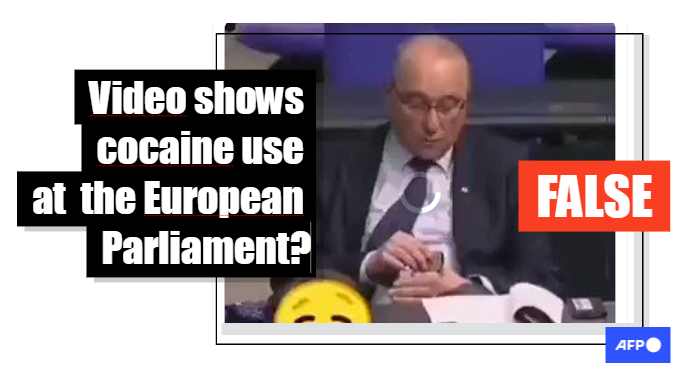
A video from 2020 of a former member of the German parliament has been shared thousands of times since March by internet users who claim that the man in question is an MEP doing cocaine during a session of the European Parliament. In reality, the man in the video — which was filmed at the Bundestag — is no longer a lawmaker and was never an MEP. While it is impossible to verify exactly what he was consuming in the video, he has spoken in the past of his fondness for snuff tobacco.

by AFP | 11.Apr 2023 | Fact check
The European Union recently gave final approval to a ban on sales of new cars with internal combustion engines from 2035. Linked to that decision is a world map that has been circulating on social media since late February and which shows Europe and California — which announced similar rules — in blue. The online posts argue that because these areas “where sales of combustion engine vehicles will be banned in 2035” represent “1/16th of the world population,” the new legislation will be useless in the fight against climate change. However, the map is incomplete: many other regions around the world have also announced such initiatives in recent years. What’s more, the EU and California represent just over a fifth of the world’s car fleet and have the potential to influence the rest of the world on the matter, experts told AFP.
by AFP | 04.Apr 2023 | Fact check
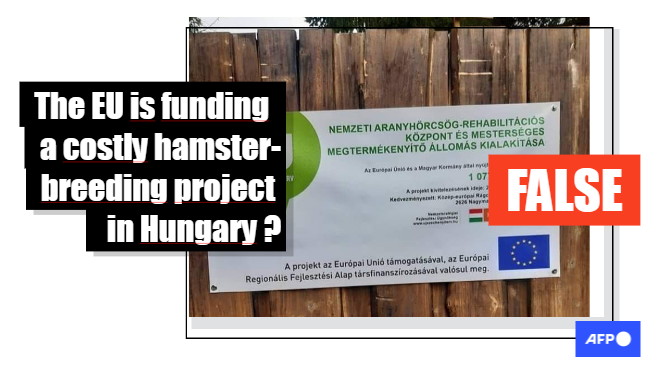
Thousands of internet users appeared to believe that the EU may spend more than 2 million euros to finance hamster breeding in Hungary. Such a project was described in a poster whose photo was widely shared on Hungarian social media in March 2023. AFP found no trace of any such EU project for the “rehabilitation and artificial insemination of golden hamsters” and confirmed that neither the address nor the company listed on the poster exists. While the Hungarian government has been suspected of irresponsible or irregular use of EU funds in the past, this particular example appears to be a case of satire.
by AFP | 28.Mar 2023 | Fact check
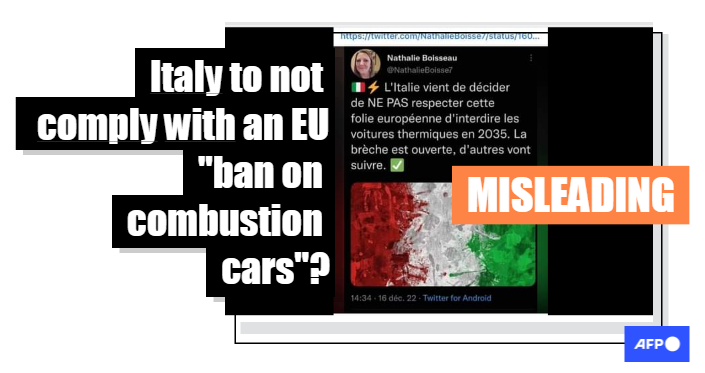
The EU ban on sales of new fossil fuel cars from 2035 is expected to be formally adopted this year. Posts shared thousands of times on Facebook and Twitter since December claim that Italy “has decided not to comply” with the ban. Yet, AFP found no trace of an official statement of the sort in the Italian press. What’s more, an EU government cannot legally refuse to implement the regulation, which is an EU law that is directly applicable to the citizens of member states. Finally, the primacy of EU law over national law is enshrined in a declaration annexed to the TFEU — the Treaty on the Functioning of the European Union — which was ratified by all EU members, European legal experts told AFP.

by AFP | 21.Mar 2023 | Fact check
The president of France’s far-right National Rally, Jordan Bardella, claimed on January 16 that EU border agency Frontex reported in a January 13 press release that 330,000 people had entered the European Union illegally in 2022. In reality, the agency did not detect 330,000 people, but 330,000 irregular entries into the EU that year. As Frontex explained to AFP, “one person can illegally cross the external border of the European Union several times” and thus be counted several times. Multiple experts interviewed by AFP mentioned the limitations of this figure. They also cautioned against reading too much into the 64 percent year-on-year increase reported by Frontex. The International Organization for Migration (IOM) estimated that nearly 188,000 people had entered Europe illegally in 2022, or an increase of 24 percent compared to 2021. A figure that is “much more reliable in terms of actual arrivals,” according to specialists.